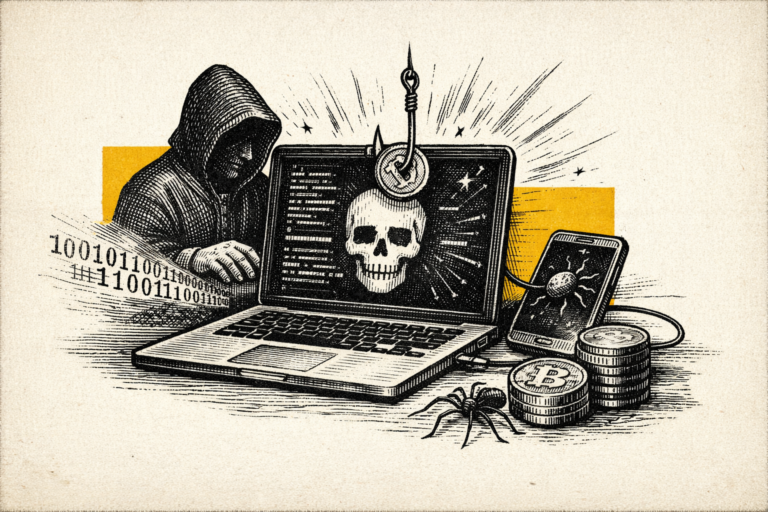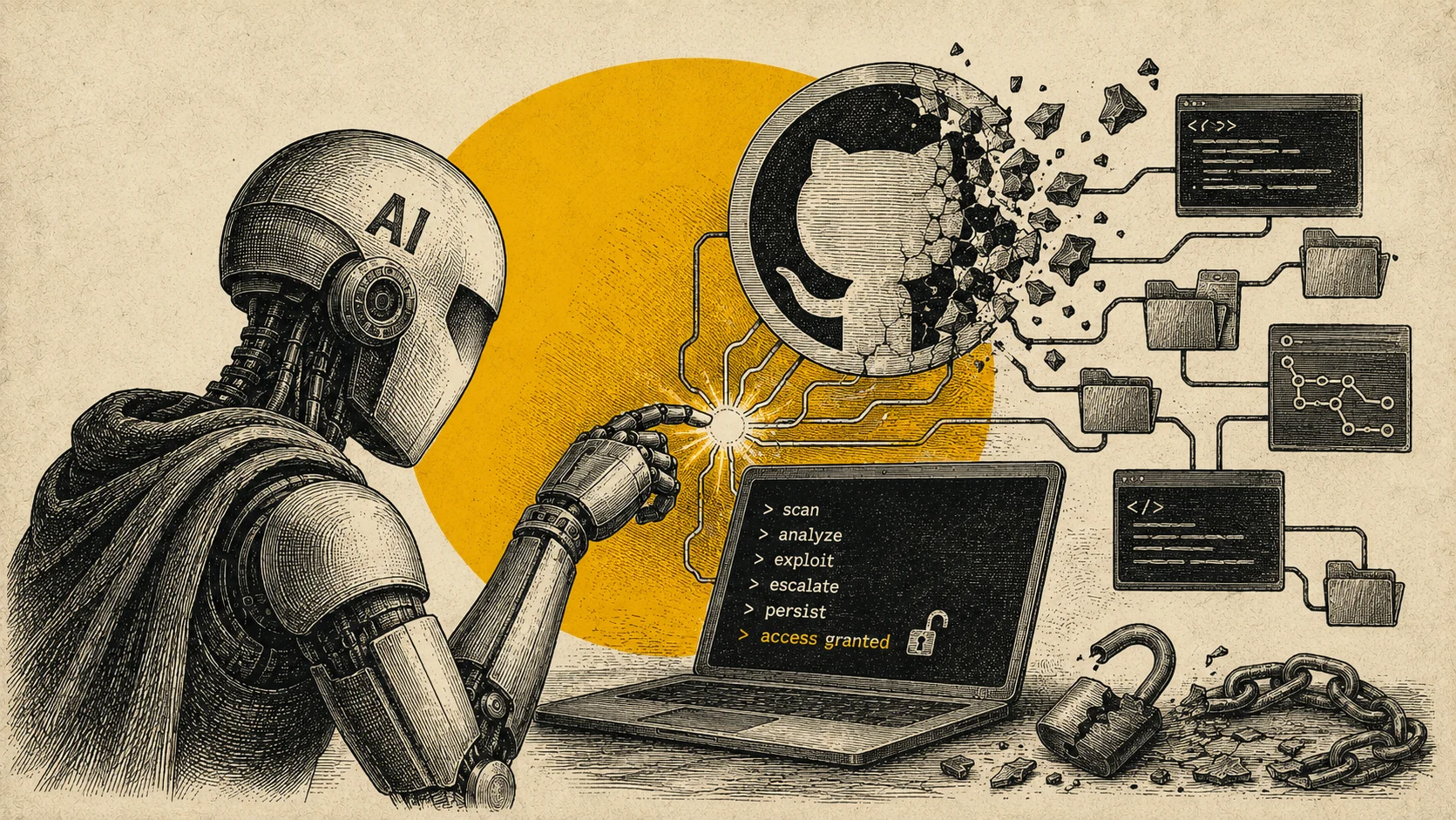
Recent reports indicate that AI agents were used in an intrusion attempt involving fake identities, the use of malware, and interaction with a project hosted on GitHub. This case reinforces concerns about autonomous agents capable of executing typical steps in an attack chain, thereby lowering the operational barrier for more sophisticated campaigns.
The incident involving the misuse of Anthropic’s AI agents in a malicious context reignites a critical discussion for companies, information security teams, developers, legal departments, compliance teams, and senior leadership: how can we protect digital environments when artificial intelligence tools begin to support recognition, task automation, code generation, pretexting, exploitation of vulnerabilities, and operational persistence? The issue is not merely technological. It involves governance, privacy, ethics, risk management, auditing, DevSecOps, cloud security, access controls, and incident preparedness.
An autonomous AI attack should not be viewed as a completely independent, perfect, or inevitable threat. In practice, it represents a combination of advanced automation, language models, programming tools, agents connected to external environments, and some level of human guidance. Even when supervised by an attacker, AI can accelerate tasks, reduce operational errors, scale operations, and enable people with less technical knowledge to perform steps previously restricted to experienced operators.
For organizations that maintain public or private repositories on GitHub, CI/CD pipelines, SaaS applications, API integrations, cloud environments, and open-source communities, this issue demands immediate attention. The attack surface is no longer limited to exposed servers, corporate endpoints, and leaked credentials. It includes issues, pull requests, dependency packages, tokens in repositories, maintainer accounts, build automations, secrets in environment variables, continuous integration runners, development bots, and code review workflows.
In this article, the main keyword is AI-powered autonomous attack. The goal is to analyze the topic in depth, explain what changes for corporate cybersecurity, identify practical risks, present best practices for implementation, and suggest maturity metrics aligned with standards such as the NIST Cybersecurity Framework, CIS Controls, ISO 27001, ISO 27002, ISO 27005, LGPD, and modern DevSecOps practices.
Table of Contents
- AI-Powered Autonomous Attacks: Context and Key Concepts
- Why the case involving Anthropic's AI agents matters to companies
- How AI agents can operate within an attack chain
- Key Risks for GitHub, DevSecOps, and the Software Supply Chain
- Impacts on Privacy, the LGPD, Compliance, and Corporate Responsibility
- Best Practices for Reducing the Risk of Autonomous AI Attacks
- Recommendations on Governance, Security, and Ethics in AI
- Technical and Operational Recommendations for Development Environments
- Evidence of maturity, controls, and compliance
- How to Prepare for Incident Response Using AI Agents
- Frequently Asked Questions on This Topic
AI-Powered Autonomous Attacks: Context and Key Concepts
One AI-powered autonomous attack It is an offensive campaign in which artificial intelligence-based tools execute, recommend, or coordinate the steps of a cyber intrusion with little direct human intervention. This may include analyzing targets, generating social engineering messages, creating scripts, attempting exploits, reading technical documentation, interacting with web interfaces, evaluating system responses, and adapting subsequent steps.
It is important to distinguish between autonomy and total independence. In many cases, the AI agent operates based on prior instructions, defined objectives, connected tools, and operational limits. The attacker can still supervise, approve actions, or correct errors. Even so, the efficiency gains are significant. An agent can test hypotheses, consult documentation, interpret error messages, adapt code, and maintain a logical sequence of tasks for hours on end—something that expands the scale of malicious campaigns.
Modern AI agents combine language models with external tools. They can access browsers, terminals, APIs, repositories, file systems, and collaboration platforms. In a legitimate environment, this improves productivity, code review, test automation, vulnerability screening, and technical support. In an offensive context, these same capabilities can be used for reconnaissance, trust manipulation, malware creation, credential abuse, exploitation of weak configurations, and movement within digital environments.
The key point for companies is not to demonize technology. Generative AI and autonomous agents are already delivering significant benefits in development, security, customer service, legal analysis, governance, and operations. The challenge is to implement controls that are proportionate to the risk. Just as the internet, the cloud, containers, and SaaS platforms required new control models, the growth of intelligent agents demands an evolution in security governance.
What Defines an AI Agent in Security
An AI agent generally consists of four components: goal, reasoning ability, action tools, and contextual memory. The goal defines what is to be achieved. Reasoning interprets information and determines next steps. Tools enable action within external systems. Contextual memory maintains a history of interactions, discoveries, and results. When these elements are combined with access to repositories, credentials, browsers, or terminals, operational risk increases.
In information security, agents can be used defensively for alert triage, enriching indicators of compromise, log analysis, anomaly detection, secure code review, and incident response support. But the same logic can be exploited by malicious actors to automate attack tasks. Therefore, the debate must move beyond the abstract realm and become part of the agenda for security controls, corporate governance, and risk management.
What's different compared to traditional attacks
In traditional attacks, automation has been around for years: scanners, botnets, phishing kits, brute-force tools, modular malware, and exploitation frameworks are well-known examples. The difference is that AI agents can interpret context, adjust strategies, generate convincing content, and handle variability. Instead of executing a fixed list of commands, an agent can assess whether a vulnerability returned an error, seek an alternative, read a configuration file, propose a fix for its own exploit, or write a socially plausible message to a project maintainer.
This adaptability reduces the operational cost of attacks. It also makes detection based solely on signatures or static patterns more difficult. A AI-powered autonomous attack It may vary in terms of text, code, and behavior with each execution. For advocates, this underscores the need for behavior-based controls, identity management, continuous monitoring, integrity validation, auditable logs, and a zero-trust architecture.
| AI-powered autonomous attack component | Implications for corporate security |
|---|---|
| Automated recognition | It speeds up the identification of repositories, endpoints, technologies, dependencies, and key personnel. |
| Generating false pretexts and identities | It increases the risk of social engineering attacks against maintainers, developers, support staff, vendors, and customer service teams. |
| Creation or modification of malicious code | It facilitates the creation of scripts and payloads, obfuscation, and the abuse of build or test automations. |
| Interaction with platforms such as GitHub | Expands risks for issues, pull requests, packages, CI/CD actions, tokens, and maintainer accounts. |
| Adaptation to Environmental Responses | It renders defenses based solely on fixed lists, signatures, and ad hoc blocks insufficient. |
Why the case involving Anthropic's AI agents matters to companies
The case involving Anthropic’s AI agents has garnered attention because it highlights a trend that warrants close monitoring: agents designed for productivity can be misused by malicious actors. Anthropic itself publishes articles on security, responsible use, and emerging threats in its research and public policy section, available at Anthropic News. Regardless of the specific details of each report, the message for companies is clear: AI controls cannot be limited to policy documents. They must be implemented in processes, technology, training, monitoring, and response.
When an AI agent is used in an intrusion attempt, the targeted company may not immediately realize that intelligent automation is behind the interactions. A comment on an issue may seem legitimate. A pull request may appear to be made in good faith. A newly created account can slowly build up a reputation. A support message may contain professional language and technical context. The problem is that AI allows these behaviors to be scaled with sufficient quality to bypass superficial human defenses.
For senior leadership, this issue matters because it affects operational risk, business continuity, regulatory exposure, reputation, intellectual property, and customer trust. For technical teams, it matters because it changes protection priorities in repositories, pipelines, and development environments. For legal and privacy teams, it matters because incidents facilitated by agents may involve personal data, sensitive data, trade secrets, and contractual liability. For audit teams, it matters because they will need to assess whether the organization has adequate controls in place for internal use and external risks related to AI.
GitHub as a Critical Attack Surface
GitHub and similar platforms are now central to digital operations. They store source code, documentation, decision histories, infrastructure scripts, configurations, dependencies, automations, and delivery workflows. A malicious change to a repository can reach production environments through automated pipelines. An exposed token can grant access to the cloud. A compromised dependency can affect thousands of users. A misled maintainer may approve code that appears harmless but contains a backdoor.
In a AI-powered autonomous attack, the agent can read the README, understand contribution guidelines, adapt the coding style, identify active maintainers, map out old issues, propose seemingly useful fixes, and insert subtle changes. This makes the human review process even more critical, but it also shows that manual review alone is not enough. It is necessary to combine peer review, static analysis, dependency checking, commit signing, branch protection, multiple approvals, segregation of duties, and pipeline observability.
Relationship to Known Threats
The use of AI does not replace classic cybersecurity fundamentals; it underscores their importance. Weak credentials remain a problem. Configuration flaws continue to be exploited. A lack of asset inventory continues to undermine defenses. The absence of logs continues to limit investigations. What has changed is the speed and quality with which an attacker can combine these elements.
That is why references such as NIST Cybersecurity Framework, CIS Controls e ISO/IEC 27001 remain highly relevant. Organizations that already have inventory management, vulnerability management, access control, incident response, data protection, and mature governance in place will be better prepared to deal with offensive AI agents. Those that still rely on informal controls will face greater challenges.
How AI agents can operate within an attack chain
To understand the risk, it is helpful to analyze how AI agents can support different stages of an attack chain. The framework MITRE ATT&CK It is a practical guide for mapping out an opponent's tactics and techniques. An AI agent can operate in several of these phases, especially when connected to tools for searching, code analysis, script generation, and interaction automation.
During the reconnaissance phase, AI can collect publicly available information about the company, the technologies it uses, its employees, repositories, domains, subdomains, packages, container images, technical documentation, and data leaks. Instead of simply listing data, the agent can synthesize hypotheses: which systems appear to be critical, which people have privileged access, which projects are active, and which dependencies may contain known vulnerabilities.
During the preparation phase, the attacker can generate and customize payloads, create social engineering messages, impersonate an external employee, write scripts to interact with APIs, build fake web pages, set up command-and-control infrastructure, or adapt malware to a specific context. During the execution phase, the agent can attempt to exploit a vulnerability, trick a user into executing code, open a malicious pull request, or abuse a CI/CD workflow.
During the persistence and evasion phase, AI can support log analysis, suggest techniques for hiding changes, renaming artifacts, obfuscating scripts, splitting payloads, and adjusting behavior to reduce detection. In the impact phase, it can help locate valuable data, prepare for exfiltration, select critical files, or maximize operational damage. This does not mean that all agents can successfully execute every task. It means that intelligent automation can support various stages that previously required more manual expertise.
Hypothetical example in an open-source project
Imagine an open-source project widely used by companies. A malicious actor analyzes the repository’s history, identifies an area with low test coverage, and notices that maintainers accept small contributions for compatibility fixes. The agent creates an account with an apparently legitimate history, comments on old issues, suggests documentation improvements, and, after some time, submits a pull request with a minimal functional change.
In the code, there is a subtle condition that changes the behavior when a specific environment variable is present. The change passes existing tests. The maintainer, under pressure from the backlog, approves the contribution. The package is published. Without additional controls, the change could make its way into production environments. This scenario illustrates why software security, code review, automated analysis, and maintainer governance are essential.
Hypothetical example in a private corporate setting
In a company with private repositories, an attacker may attempt to gain access by phishing developers. Based on publicly available data, the attacker creates a message about an alleged vulnerability in a library used by the company. The link leads to a fake authentication page. If the developer does not use phishing-resistant multi-factor authentication, their credentials can be stolen. With access to the corporate GitHub, the attacker searches for secrets, API keys, cloud tokens, and CI/CD workflows.
If the controls are weak, an attacker could insert a step into a pipeline to exfiltrate environment variables, modify a container image, or alter a deployment script. A AI-powered autonomous attack It could speed up the analysis of repositories and suggest avenues for exploration based on available permissions. The risk lies not only in the AI model, but in the combination of offensive automation and existing control failures.
| Phase of the attack chain | How AI Can Be Misused |
|---|---|
| Acknowledgments | Mapping of repositories, people, technologies, dependencies, exposed credentials, and public documentation. |
| Social engineering | Creating personalized messages, fake identities, convincing comments, and technical excuses. |
| Exploitation | Script generation, exploit adaptation, API abuse, fuzz testing, and pipeline manipulation. |
| Persistence | Inserting subtle backdoors, modifying workflows, creating tokens, and using compromised accounts. |
| Evasion and Impact | Code obfuscation, trace reduction, selective exfiltration, and preparation for disruptive actions. |
Key Risks for GitHub, DevSecOps, and the Software Supply Chain
The risk of AI-powered autonomous attack This is particularly relevant for development environments because they contain sensitive assets and powerful automations. Source code reveals business logic, integrations, keys, endpoints, libraries, and architecture. CI/CD pipelines may be authorized to publish packages, create infrastructure, update environments, and access secrets. Developer accounts, in turn, often have access to multiple repositories and supporting systems.
Modern software security requires integration between development, operations, and security. That is the purpose of DevSecOps: to incorporate controls from planning through continuous delivery. To learn more about this concept, see the article What is DevSecOps?. In a scenario involving offensive AI agents, DevSecOps is no longer just a desirable best practice but becomes an essential layer of protection against malicious alterations, automation abuse, and supply chain compromise.
Risks in Public Repositories
Public repositories are visible to anyone, including automated agents. This does not mean they should be avoided. Open-source projects are essential for innovation. The problem arises when there is no governance of contributions, code validation, protection of maintainers, or control over publication. AI agents can analyze review patterns, identify overburdened maintainers, propose changes that appear legitimate, and exploit gaps in testing.
Another risk is the accidental exposure of sensitive information. Configuration files, examples, logs, commit histories, and documentation may contain internal endpoints, bucket names, tokens, old keys, network topologies, or vendor details. Even if credentials have expired, this information aids in recognition. An agent can correlate scattered data and build an attack map more quickly than a human operator.
Risks in Private Repositories
Private repositories reduce public exposure, but they do not eliminate risks. Compromised accounts, excessive permissions, tokens without expiration dates, third-party integrations, and notebooks containing sensitive data remain vectors of attack. Many organizations grant broad access to teams, vendors, and automated tools without periodic review. In an incident, an attacker can use AI to search for patterns in secrets, locate relevant files, interpret pipelines, and identify the most efficient path to escalate privileges.
Third-party management also warrants attention. Consulting firms, freelancers, software vendors, and partners may have access to repositories or test environments. If one of these third parties is compromised, the company may be indirectly affected. This topic is directly related to supply chain risks, which are discussed in the article Cyberattacks on Suppliers: Risks and Controls.
Risks in CI/CD Pipelines
CI/CD pipelines are valuable targets because they automate critical actions. A workflow can compile code, run tests, access secrets, publish artifacts, create container images, update cloud environments, and trigger deployments. If an attacker modifies a pipeline or exploits an insecure configuration, they can execute commands with elevated privileges.
Some common risks include shared runners without proper isolation, automatic execution of code from external pull requests, broad permissions for default tokens, secrets accessible to forks, a lack of review for workflow changes, and a lack of detailed logs. One AI-powered autonomous attack It can identify exactly these configurations and suggest ways to exploit them. For this reason, pipelines should be treated as critical systems, not just as productivity tools.
Risks in dependencies and packages
The software supply chain relies on third-party libraries, packages, images, plugins, and tools. Attacks such as dependency confusion, typosquatting, package takeover, and the injection of malicious code into popular libraries are already well-known. AI can accelerate the creation of fake packages with convincing documentation, plausible names, working examples, and seemingly legitimate behavior.
Companies should maintain an inventory of software components—also known as an SBOM—monitor vulnerabilities, pin versions, validate the source of packages, use internal repositories, and review new dependencies. The use of SCA tools, license analysis, and approval policies helps reduce risk. However, maturity depends on the process: someone needs to review exceptions, prioritize fixes, and ensure that critical components are updated.
Impacts on Privacy, the LGPD, Compliance, and Corporate Responsibility
One AI-powered autonomous attack It may have significant implications for privacy and data protection. If the campaign results in unauthorized access to databases, logs, test environments, tickets, repositories, or documents, personal data may be exposed. Under the LGPD, organizations must adopt security, technical, and administrative measures capable of protecting personal data against unauthorized access and accidental or unlawful situations involving destruction, loss, alteration, disclosure, or dissemination.
A National Data Protection Authority It is the Brazilian institutional authority for guidelines on personal data protection. In the event of significant incidents, it may be necessary to assess whether to notify the ANPD and the data subjects, depending on the risk or significant harm involved. The analysis should take into account the nature of the data, the volume of data, the affected data subjects, the possibility of identification, mitigation measures, potential impact, and available evidence.
From a compliance perspective, incidents involving AI repositories and agents can affect contractual obligations, certifications, audits, customer requirements, industry standards, and internal policies. A company that is ISO 27001 certified or in the process of obtaining certification will need to demonstrate that it has risk management in place, controls implemented, defined responsibilities, incident handling procedures, vendor evaluations, and a process for continuous improvement. Simply using modern tools is no substitute for evidence of governance.
Responsibility for the Internal Use of AI
In addition to external risks, companies need to govern the internal use of AI agents. Developers can connect assistants to repositories, knowledge bases, tickets, and test environments. Analysts may paste logs, personal data, or code snippets into unapproved tools. Business teams may use platforms without evaluating their security, privacy, and contractual terms. Without a clear policy, the organization is exposed to information leaks, data misuse, and reliance on unapproved tools.
Governance must define which tools are permitted, what data can be processed, which integrations require approval, how logs are stored, who reviews vendors, which contractual requirements are mandatory, and how incidents involving AI will be handled. This must be documented, communicated, and audited. AI security cannot rely solely on informal guidance.
Privacy by Design
Privacy by design means considering data protection from the very beginning of the design of processes and systems. For AI agents, this involves data minimization, access control, anonymization when possible, limited retention, prompt review, log governance, evaluation of training datasets, and monitoring of outputs. If an agent accesses repositories containing large amounts of personal data, the company must justify the need, limit the scope, and document the controls.
When agents are used for defensive security purposes, such as incident analysis or log screening, there is also a risk of personal data exposure. Logs may contain email addresses, IP addresses, identifiers, tokens, and behavioral information. Responsible use requires information classification, masking, environment segregation, and appropriate contracts with vendors.
Best Practices for Reducing the Risk of Autonomous AI Attacks
Reduce the risk of AI-powered autonomous attack requires a combination of security fundamentals, controls specific to development environments, and AI governance. The first recommendation is to avoid purely reactive responses. Blocking a specific tool or issuing a generic policy rarely solves the problem. The organization needs to understand its critical assets, its development workflows, its vendors, its sensitive data, and its access permissions.
Best practices should be prioritized based on risk. Companies with public repositories, digital products, exposed APIs, complex pipelines, and distributed teams need more robust controls. Smaller organizations should also take action, but they can start with measures that have the greatest impact: multi-factor authentication, branch protection, secret scanning, permission reviews, backups, dependency inventories, and social engineering training.
Strengthening Identity and Access
Identity is one of the most important controls. Developers, maintainers, repository administrators, service accounts, and integrations must use strong authentication. Whenever possible, adopt phishing-resistant MFA, such as FIDO2/WebAuthn security keys. Reduce administrative permissions, apply the principle of least privilege, review access rights periodically, and remove inactive accounts.
Personal tokens, SSH keys, and automation credentials must have minimal scope, expiration dates, and rotation policies. Service accounts must be identifiable, monitored, and assigned to responsible parties. The use of shared credentials must be eliminated. In critical environments, administrative actions must require approval, logging, and alerts.
Protecting repositories and branches
Main branches must have protection rules. Require peer review, mandatory status checks, automated testing, force push blocking, and special review for changes to workflows, build files, dependencies, and security configurations. For sensitive projects, consider requiring commit signatures, provenance verification, and approval by CODEOWNERS.
External pull requests should be handled with care. Do not automatically run untrusted code with access to secrets. Separate test environments from environments containing sensitive credentials. Review permissions for GitHub Actions or equivalent tools. Changes to CI/CD scripts should receive special attention, as they can be used to exfiltrate variables and tokens.
Implement a scan for secrets and dependencies
Secret scanning should occur in real time and retrospectively whenever possible. Native GitHub tools and specialized solutions can detect keys, tokens, and credentials. When a secret is exposed, the correct course of action is not simply to delete the file. You must revoke the credential, investigate misuse, rotate related keys, and log the incident.
Dependencies must be monitored continuously. Use SCA to identify known vulnerabilities, incompatible licenses, and suspicious packages. Establish policies for adding new libraries. Check the package’s reputation, maintainers, update frequency, security history, and actual need. A small package can introduce significant risk if used in a critical path.
Implement controls aligned with the CIS Controls
The CIS Controls offer a pragmatic approach to prioritizing security controls. The article What are the CIS Controls? helps explain this reference. In the context of AI agents and GitHub, certain controls are particularly relevant: asset inventory, software inventory, data protection, secure configuration management, account control, access management, logs, malware protection, vulnerability management, awareness, incident response, and application security.
The value of the CIS Controls lies in their objectivity. They help organizations move beyond abstract discussions and implement verifiable measures. To reduce the risk of AI-powered autonomous attack, the company should identify which controls are already in place, which are incomplete, and which need improvement. This assessment also facilitates audits and communication with executives.
| Best practice | Expected result |
|---|---|
| Phishing-resistant MFA for critical accounts | Reduced risk of compromise due to phishing, credential theft, and social engineering. |
| Branch Protection and Mandatory Review | A lower likelihood that malicious code will reach production environments without validation. |
| Secret scanning and credential rotation | Rapid detection of exposed keys and reduction of the exploitation window. |
| SCA, SBOM, and Dependency Management | Greater visibility into software components and supply chain risks. |
| Log Monitoring and Behavioral Alerts | Identification of anomalous access, suspicious changes, and abuse of automated systems. |
Recommendations on Governance, Security, and Ethics in AI
AI governance should be treated as part of corporate governance and security governance. It is not enough to simply create a token committee. It is necessary to define roles, policies, approval criteria, an inventory of solutions, risk assessments, contractual requirements, metrics, auditing, and accountability mechanisms. The internal adoption of AI agents must be secure, ethical, and aligned with business objectives.
A mature program should distinguish between low-, medium-, and high-risk uses. An assistant designed to summarize public texts poses a different risk than an agent with access to private repositories, customer tickets, security logs, or personal data. The higher the risk, the stricter the controls should be: privacy assessment, security analysis, legal review, scope limitation, monitoring, usage logging, and formal approval.
AI Acceptable Use Policy
The acceptable use policy should explain which tools are approved, what information may not be posted on external platforms, and how to handle personal data, source code, trade secrets, credentials, and confidential documents. It should also provide guidance on response validation, human oversight, and the prohibition of use for activities that are illegal, discriminatory, or contrary to corporate ethics.
This policy must be understandable to both technical and non-technical staff. A generic rule such as “use AI responsibly” is insufficient. The document should include practical examples: do not paste API keys into prompts, do not send customer data without authorization, do not connect agents to production systems without approval, do not automatically accept generated code without review, and do not use personal accounts for corporate activities.
Inventory and Risk Assessment of AI Solutions
Companies must maintain an inventory of officially used AI tools and, when possible, identify unauthorized use, known as “shadow AI.” Each solution must be evaluated for its purpose, the data processed, the vendors involved, the location of processing, data retention, use for training, logs, access controls, encryption, integration with internal systems, and auditability.
This assessment must take third-party risks into account. AI providers may process sensitive information, store prompts, integrate APIs, and offer agents with broad permissions. Contracts must address confidentiality, data protection, subprocessors, incidents, data deletion, auditing, business continuity, and liability. The legal, privacy, security, and procurement departments must work together.
Ethics and Human Responsibility
The defensive use of AI in security must ensure human oversight, proportionality, and respect for rights. An agent that recommends user blocking, risk classification, or incident response can impact people and operations. Therefore, critical decisions must include human review, documented criteria, and the possibility of appeal when applicable.
On the offensive side, the organization must make it clear that corporate tools cannot be used for malicious activities. Security teams conducting authorized tests, such as penetration tests and red team exercises, require a formal scope, approval, rules of engagement, data controls, and documentation. The use of AI in these tests must be transparent to those in charge and aligned with legal and contractual limits.
Technical and Operational Recommendations for Development Environments
In addition to governance, it is necessary to implement consistent technical controls. Development environments tend to grow rapidly, with multiple repositories, SaaS tools, integrations, tokens, and permissions. Without standardization, permanent exceptions, orphaned accounts, and insecure pipelines arise. A AI-powered autonomous attack tends to exploit precisely those weaknesses.
Security on GitHub and Similar Platforms
Start by reviewing your organization on GitHub or an equivalent platform. Check owners, administrators, teams, permissions, archived repositories, public repositories, webhooks, GitHub Apps, OAuth Apps, tokens, SSH keys, branch rules, and security settings. Many companies discover during audits that there are repositories with no clear owner, outdated integrations with broad permissions, and users who no longer belong to the organization.
Enable available security features, such as secret scanning, Dependabot, or equivalent tools, code scanning, and vulnerability alerts. Configure policies to prevent the pushing of secrets whenever possible. Set minimum standards for new repositories. Critical repositories must have a classification, a business owner, a technical owner, an access matrix, review requirements, and publishing procedures.
CI/CD Hardening
The pipeline must follow the principle of least privilege. Tokens used by workflows must have minimal permissions. Secrets must be segmented by environment and released only when necessary. Runners must be isolated, updated, and monitored. Workflows from forks or external contributions should not automatically receive secrets. Changes to workflow files must require approval from trusted maintainers.
It is also recommended to implement artifact signing and verification. SLSA, Sigstore, in-toto, and provenance practices help demonstrate the origin and integrity of components. Although implementation varies depending on maturity, the goal is clear: to reduce the likelihood that a malicious artifact will be published or consumed without being detected.
Behavioral Monitoring and Detection
Audit logs are essential. Monitor token creation, permission changes, the addition of SSH keys, changes to protected branches, workflow modifications, package publishing, the disabling of controls, logins from unusual locations, and bulk access to repositories. Integrate these events with the company’s SIEM or detection platform.
Since AI agents can vary in their behavior, static rules must be supplemented with behavioral analysis. Examples of useful alerts include: a developer account accessing too many repositories outside its usual pattern, a pipeline change followed by an unusual failure, an external pull request modifying a build script, a newly created token accessing secrets, or a maintainer approving a sensitive change without a second review.
Training aimed at developers and maintainers
General awareness of phishing is important, but not enough. Developers need to understand supply chain attacks, risks in pull requests, secrets, dependencies, pipelines, and maintainer accounts. Training should include real or simulated examples, exercises in reviewing malicious code, analysis of suspicious packages, and guidance on the safe use of AI in development.
It is also recommended to establish clear reporting channels. If a maintainer suspects a suspicious contribution, a fake account, or automated behavior, they should know how to alert security without excessive red tape. Quick responses minimize damage. The culture should encourage technical questioning and not penalize those who report legitimate concerns.
Evidence of maturity, controls, and compliance
In information security, simply stating that controls exist is not enough. Evidence must be provided. For audits, certifications, client due diligence, and incident investigations, the organization must present records, policies, reports, tickets, logs, meeting minutes, metrics, and test results. In the context of AI-powered autonomous attack, evidence of maturity helps demonstrate diligence and continuous improvement.
ISO 27001 requires an information security management system based on risk, continuous improvement, and appropriate controls. The NIST CSF organizes practices into functions such as Govern, Identify, Protect, Detect, Respond, and Recover. The CIS Controls help prioritize technical measures. The LGPD reinforces technical and administrative measures for the protection of personal data. Together, these references provide a solid foundation for structuring evidence.
Evidence of governance
Evidence of governance includes an approved AI usage policy, an inventory of AI tools, a risk assessment record, a responsible committee or forum, a RACI matrix, data classification criteria, meeting minutes, a risk treatment plan, periodic vendor reviews, and reports to senior leadership. It is also helpful to keep a record of approved exceptions, including the rationale, deadline, and person responsible.
A mature company is able to answer questions such as: Which AI agents are authorized? Which systems do they access? What data can they process? Who approved it? What controls have been implemented? How will incidents be handled? How is risk reported to executives? If these answers depend on informal knowledge, maturity is still low.
Technical evidence
Technical evidence includes exported repository configurations, audit logs, secret scan reports, SCA alerts, static analysis results, branch protection rules, lists of CODEOWNERS, pull request approval records, token inventories, MFA policies, SIEM logs, and security testing reports.
Other relevant evidence includes the results of incident response exercises, repository compromise simulations, backup restoration tests, analysis of token revocation capabilities, and validation that secrets are not exposed to external pull request pipelines. For highly critical environments, authorized penetration tests and red teams can assess whether controls can withstand modern techniques. The article What Is a Penetration Test, and How Do You Choose One? explores the criteria for this type of evaluation in greater depth.
Useful Metrics
Metrics should support decision-making, not just fill out reports. Useful examples include the percentage of accounts with phishing-resistant MFA, the number of repositories with branch protection, the average time to revoke an exposed secret, the percentage of critical dependencies patched within the SLA, the number of orphaned repositories, the time to detect suspicious changes in the pipeline, and the percentage of vendors with up-to-date security assessments.
It is also recommended to measure AI adoption maturity: the number of tools inventoried, the percentage of tools assessed for security and privacy, the number of open exceptions, incidents related to misuse, completed training sessions, and reviews of prompts or critical integrations. These metrics help turn this issue into an ongoing management process.
| Evidence | This demonstrates |
|---|---|
| AI Usage Policy Approved and Communicated | The existence of formal guidelines for the safe, ethical, and controlled use of AI. |
| Inventory of agents, integrations, and tools | Insight into the technologies used and risk management capabilities. |
| Secret scanning and SCA reports | Active monitoring of exposed credentials and vulnerabilities in dependencies. |
| Audit logs integrated with SIEM | Ability to detect, investigate, and respond to suspicious behavior. |
| Simulations and response exercises | Operational preparedness for incidents involving data repositories, AI, and the supply chain. |
How to Prepare for Incident Response Using AI Agents
Incident response must evolve to account for scenarios in which AI agents are involved in the campaign. This does not mean creating a completely separate plan, but rather updating existing playbooks. Incidents involving AI repositories, pipelines, credentials, dependencies, and tools must have clear procedures for identification, containment, eradication, recovery, and lessons learned.
The first step is to define triggers. Examples include detection of exposed secrets, suspicious changes to a workflow, malicious pull requests, compromised maintainer accounts, improperly published packages, unauthorized use of an agent connected to internal data, or evidence of automated social engineering. Each scenario should specify responsible parties, communication channels, severity criteria, and initial actions.
Containment
In incidents involving GitHub or CI/CD, mitigation measures may include revoking tokens, suspending compromised accounts, temporarily blocking pipelines, adding additional protection to branches, removing suspicious integrations, rotating secrets, blocking package publishing, and isolating runners. It is essential to log actions to maintain traceability.
If there is suspicion that an internal AI agent has been misused, mitigation measures may include suspending the integration, preserving logs, reviewing permissions, and assessing the data accessed. The company must strike a balance: preserving evidence without increasing exposure and without disrupting operations more than necessary.
Research
The investigation should reconstruct the timeline. Who accessed the system? From where? Which repositories were accessed? Which files were modified? Which secrets were available? Which pipelines ran? Which artifacts were published? Was there any access to personal data? Which vendors or customers may have been affected?
When AI is involved, it is also helpful to analyze language patterns, interaction speed, newly created accounts, repetitive behaviors, the use of automation, and connections to external infrastructure. However, the investigation should not rely on assumptions about “AI-generated text,” as such detectors can be inaccurate. The focus should be on behavior, technical evidence, and impact.
Recovery and Continuous Improvement
After containing and resolving the issue, the recovery process must validate the integrity of the code, artifacts, environments, and data. It may be necessary to revert commits, republish packages, rebuild images, restore environments, notify users, inform authorities, update keys, and review controls. The validation must be documented.
Lessons learned are essential. An incident must lead to concrete improvements: adjustments to branch security, changes to token permissions, new training, playbook updates, vendor reviews, enhanced logging, or changes to AI policies. Without this step, the company remains vulnerable to variations of the same attack.
The rise of AI agents used for malicious purposes does not eliminate the need for security fundamentals; it makes those fundamentals even more urgent. Organizations that know their assets, control access, protect repositories, monitor pipelines, train teams, evaluate vendors, and maintain incident response capabilities will be better equipped to deal with automated and adaptive campaigns.
The case involving Anthropic’s AI agents should be viewed as a sign of the maturity the market needs. The discussion should not be limited to fear or the indiscriminate blocking of technology. The most consistent approach is to regulate the use of AI, strengthen information security, integrate privacy and compliance, apply DevSecOps best practices, and continuously measure the effectiveness of controls.
One AI-powered autonomous attack It can lower the operational barrier for adversaries, but it can also serve as a catalyst for companies to improve their security processes, evidence, architecture, and culture. The priority should be practical: review identities, secure repositories, harden pipelines, inventory AI tools, assess risks, prepare a response, and engage senior leadership. Security is not an end state; it is an organizational capability that must evolve at the same pace as threats.
Frequently Asked Questions on This Topic
How can a company begin to protect itself against an autonomous AI attack on GitHub repositories?
The first step is to review repository identities, permissions, and configurations. Enable MFA for critical accounts, apply branch protection, require peer review, enable secret scanning, review tokens, and integrate logs into security monitoring. At the same time, create an AI usage policy, maintain an inventory of authorized tools, and train developers to recognize suspicious contributions, social engineering, and risks in CI/CD pipelines.
What evidence shows that safeguards against malicious AI agents are working?
Useful evidence includes secret scanning reports, audit logs, pull request review records, branch protection rules, token inventories, SCA alerts, vulnerability remediation metrics, incident simulation results, and AI governance minutes. It is also important to demonstrate that exceptions are controlled, that access is reviewed periodically, and that incidents result in documented corrective actions.
How does an autonomous AI attack relate to the LGPD, ISO 27001, NIST, and CIS Controls?
The LGPD requires technical and administrative measures to protect personal data against unauthorized access and incidents. ISO 27001 provides guidance on establishing a risk-based security management system. The NIST CSF organizes capabilities related to governance, identification, protection, detection, response, and recovery. The CIS Controls help prioritize practical measures, such as inventory, access control, logs, vulnerability management, and application security.
What are the main mistakes companies make when working with AI agents in software development?
The most common mistakes include allowing the informal use of AI tools without evaluation, granting excessive permissions to agents and integrations, failing to protect branches, executing external code with exposed secrets, ignoring audit logs, failing to review dependencies, and treating pipelines as mere automations. Another mistake is believing that human review alone is sufficient, without the support of automated analysis, policies, and continuous monitoring.
How can a company assess its readiness to handle an autonomous AI attack?
Maturity can be measured by indicators such as the percentage of accounts with strong MFA, repositories with branch protection, secret revocation time, SCA coverage, log integration with SIEM, periodic access reviews, inventory of AI tools, completed risk assessments, and response exercises conducted. The more standardized, auditable, and tested the controls are, the higher the maturity level will be.
Which areas should be involved in security governance for AI use and repository protection?
The following teams should be involved: information security, technology, software engineering, DevOps, privacy, legal, compliance, auditing, procurement, third-party management, and business unit leadership. In companies with digital products, product owners and architects should also be involved. Governance works best when responsibilities are clear and risk decisions are documented.
What risks arise when a company neglects AI agents connected to source code and internal data?
The main risks include source code leaks, exposure of personal data, misuse of trade secrets, compromised credentials, malicious tampering with pipelines, publication of compromised artifacts, and failure to comply with regulatory or contractual obligations. There is also reputational risk, especially if customers perceive a lack of control over tools that access sensitive information.
How can we distinguish between legitimate use of AI in DevSecOps and suspicious or malicious behavior?
Legitimate use must involve approved tools, a defined scope, identifiable accounts, minimal permissions, available logs, and human oversight. Suspicious behaviors include non-standard access, unexpected token creation, unjustified changes to workflows, external pull requests modifying sensitive scripts, large-scale interaction with repositories, and the use of unapproved tools to process confidential data.
What technical controls are most important for preventing AI agents from abusing CI/CD pipelines?
The most important controls include minimum permissions for tokens, runner isolation, segmentation of secrets by environment, blocking of secrets in external pull requests, mandatory review of changes to workflows, artifact signing, detailed logs, and alerts for sensitive changes. It is also recommended to separate test and production environments and to periodically review third-party integrations.
How to develop an incident response plan for a suspected autonomous AI attack?
The plan must define triggers, responsible parties, communication channels, severity criteria, and mitigation actions. Include procedures for revoking tokens, suspending accounts, preserving logs, blocking pipelines, reviewing commits, validating artifacts, assessing personal data exposure, and notifying stakeholders when necessary. After the incident, document lessons learned and update controls, training, and playbooks.