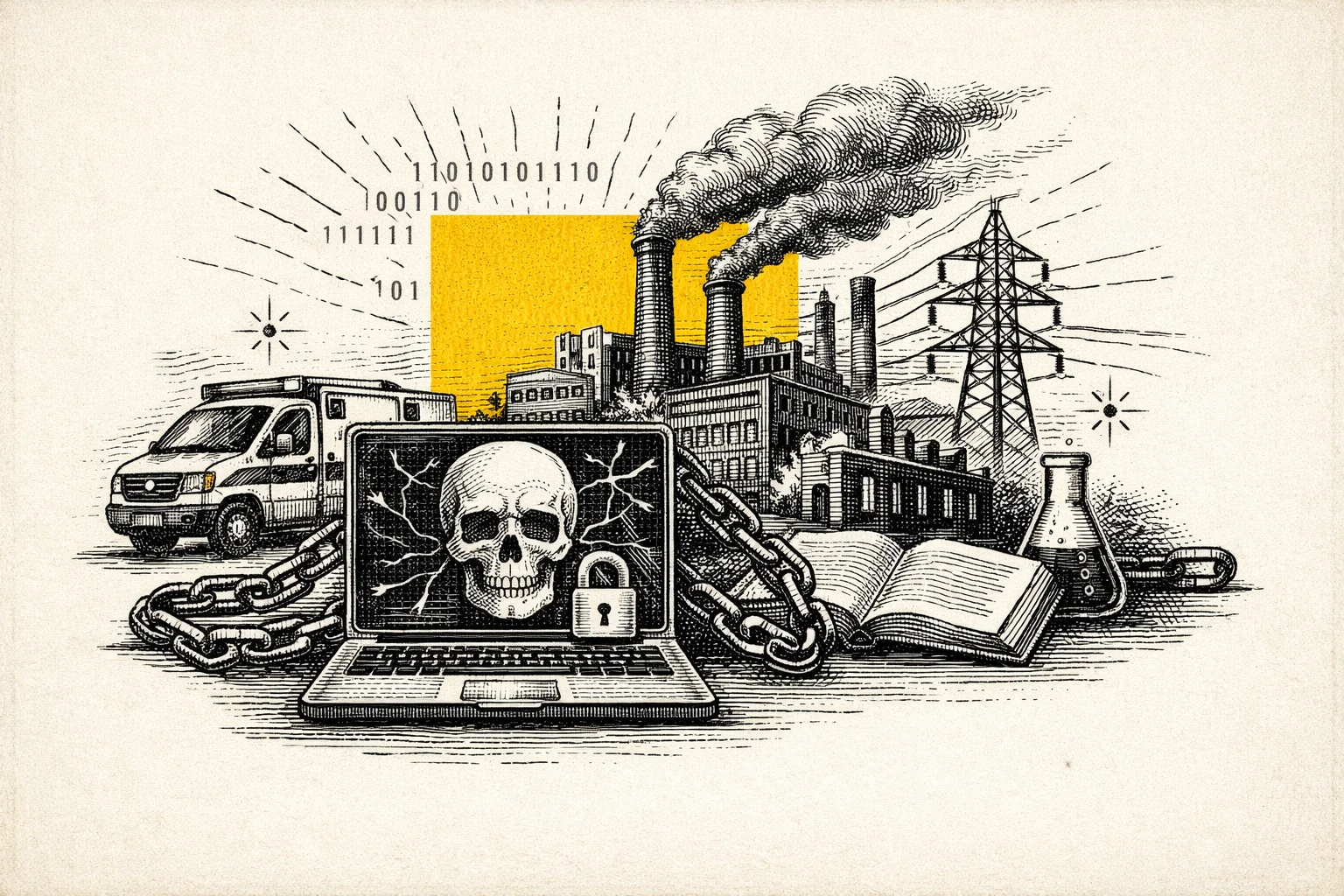
A new sequence of incidents and reports shows that ransomware continues to advance across critical sectors, with operational impacts ranging from diverted ambulances to libraries going offline and factories being shut down. Reports also point to increased volume in specific markets, greater credential exposure, and slower recovery after attacks.
This scenario reinforces an important conclusion for boards, executive leadership, technology teams, information security, legal, compliance, audit, and business continuity areas: ransomware in critical sectors is no longer just a technical problem. It has become a corporate, operational, regulatory, reputational, and, in many cases, social risk. When hospitals reduce care, when an industry interrupts production lines, when public services become unavailable, or when energy companies suffer outages in essential systems, the impact goes beyond the digital environment and affects people, supply chains, and entire communities.
The global escalation of ransomware in critical sectors also highlights a shift in how criminal groups operate. Modern attacks combine credential theft, vulnerability exploitation, abuse of remote access, lateral movement, data exfiltration, double or triple extortion, pressure on customers and partners, public exposure of information, and attacks against backups. Instead of merely encrypting files, attackers seek to maximize negotiating power, increase damage, and reduce victims’ ability to recover.
To deal with this environment, organizations need to go beyond point solutions. The response requires security governance, risk management, technical controls, continuity plans, incident response, third-party management, data protection, privacy, training, audit, and maturity metrics. Frameworks such as the NIST Cybersecurity Framework, CIS Controls, ISO 27001, ISO 27002, and ISO 27005 provide useful references, but their effectiveness depends on practical implementation, evidence, and leadership involvement.
Table of Contents
- Ransomware in critical sectors as a corporate risk
- Why healthcare, industry, energy, and public services are targets
- Main attack vectors and tactics used by ransomware groups
- Operational, financial, regulatory, and reputational impacts
- Governance, risk management, and the role of senior leadership
- Security controls to reduce ransomware risk
- Business continuity, recovery, and digital resilience
- Data protection, LGPD, and compliance obligations
- Third-party management, supply chain, and cloud risk
- Maturity evidence, audit, and security metrics
- Practical plan to strengthen ransomware defense
- Frequently asked questions on the topic
Ransomware in critical sectors as a corporate risk
Ransomware in critical sectors should be understood as a high-severity corporate risk, not merely as a technology event. In its best-known form, ransomware is a type of attack in which systems, files, or entire environments are encrypted by malicious actors, who demand payment to release decryption keys. However, this definition is no longer enough to explain today’s reality. Today, many incidents also involve data exfiltration, threats of disclosure, contact with customers, operational disruption, selective leaking of documents, and public pressure.
Critical sectors are those whose disruption can cause significant harm to society, the economy, health, safety, or the basic functioning of essential services. Healthcare, industry, energy, sanitation, telecommunications, transportation, government, education, financial services, and public services are among the most sensitive segments. In all of them, dependence on digital systems has increased significantly, expanding the attack surface and raising the criticality of cybersecurity.
When ransomware in critical sectors affects a hospital, the problem may involve unavailable medical records, delays in exams, canceled surgeries, ambulance diversions, and clinical decision-making with less information. When it hits industry, it can halt production lines, affect industrial control systems, prevent billing, delay deliveries, and generate contractual penalties. In energy and public services, unavailability can compromise citizen service, field operations, monitoring, maintenance, and emergency response.
The sophistication of attacks has also increased. Criminal groups operate with structures similar to those of companies, including role division, affiliates, negotiation channels, technical support for payment, organized data leaks, and prior analysis of the victim’s financial capacity. The model known as ransomware-as-a-service allows less technical criminals to use ready-made platforms, increasing the global scale of campaigns.
From file encryption to multifactor extortion
In the past, many organizations associated ransomware only with file encryption on workstations. Today, that view is insufficient. Attackers seek privileged credentials, exploit unpatched VPNs, abuse exposed services, compromise servers, disable security tools, delete shadow copies, attack backup environments, and attempt to compromise corporate directories. The goal is to broaden the impact before revealing their presence.
In many cases, encryption is only the final stage. Before that, attackers may remain in the environment for days or weeks, mapping assets, identifying sensitive data, collecting credentials, creating persistence, and assessing which systems are most critical to operations. This dwell time increases potential damage and requires companies to invest in detection, response, and monitoring, not just prevention.
Why the topic requires business language
One of the main mistakes in managing ransomware in critical sectors is treating the topic exclusively in technical language. Although security controls are essential, decisions about risk tolerance, investment, continuity, communication, insurance, third parties, data protection, and incident response must involve senior leadership. The question is not just “which tool should we buy?”, but “what level of disruption can the organization withstand, for how long, and with what legal, operational, and human impacts?”.
This discussion should appear in risk committees, boards of directors, executive meetings, and strategic planning processes. Information security maturity depends on the ability to translate technical threats into business scenarios, probable losses, regulatory obligations, critical dependencies, and investment priorities.
Why healthcare, industry, energy, and public services are targets
The escalation of ransomware in critical sectors does not happen by chance. These environments share characteristics that make them attractive to criminals: high operational dependence, low tolerance for unavailability, large volumes of sensitive data, the presence of legacy systems, third-party complexity, growing connectivity, and pressure for rapid recovery. The greater the impact of a shutdown, the greater the pressure to negotiate may be.
In the healthcare sector, urgency of care creates an especially sensitive environment. Hospitals, clinics, laboratories, and health insurers process sensitive personal data, including clinical information, exams, diagnoses, medical history, financial data, and identification documents. The unavailability of this data can directly affect care delivery. In addition, many hospital environments use connected medical devices and older systems that do not always receive regular updates.
In industry, the convergence between information technology and operational technology has increased risks. Manufacturing systems, production control, automation, sensors, robotics, supervisory systems, and industrial networks were often designed with availability and physical safety in mind, not necessarily cybersecurity. Connecting these environments to corporate networks, suppliers, remote maintenance, and cloud platforms creates opportunities for lateral movement and operational impact.
Energy and public service companies deal with essential infrastructure. Even when critical control systems are segregated, administrative areas, customer service, billing, logistics, procurement, team dispatch, and customer communication depend on technology. An attack that paralyzes these processes can hinder operations, delay responses, and undermine public trust.
Factors that increase the attractiveness of critical sectors
- Low tolerance for unavailability: critical services cannot remain offline for long periods without significant impact.
- Sensitive and valuable data: health information, contracts, industrial projects, citizen data, and internal documents can be used for extortion.
- Legacy environments: older systems may not support modern patches, strong authentication, or proper monitoring.
- Operational complexity: multiple units, suppliers, integrations, and systems make inventory, updates, and response more difficult.
- Dependence on third parties: cloud providers, software, maintenance, remote support, and managed services can expand the attack surface.
- Reputational pressure: disruptions in critical sectors attract public, regulatory, and media attention.
Risk comparison by sector
| Sector | Main ransomware impacts | Most sensitive data and assets |
|---|---|---|
| Healthcare | Delays in care, ambulance diversion, canceled exams, unavailable medical records. | Sensitive personal data, medical records, exams, prescriptions, hospital systems. |
| Industry | Factory shutdowns, production loss, delivery delays, impact on OT and logistics. | Industrial formulas, projects, production systems, supplier and customer data. |
| Energy | Disruption of administrative and operational processes, delays in maintenance and service. | Monitoring systems, customer data, operational assets, corporate networks. |
| Public services | Unavailable portals, impaired service, delays in benefits and citizen services. | Citizen data, records, documents, service and tax collection systems. |
Another relevant factor is dependence on widely used systems. Vulnerabilities in popular technologies can generate waves of exploitation at scale. Cases involving mass patching, flaws in corporate software, and exploitation of legacy protocols show that vulnerability management must be continuous. A useful example for reflection is the analysis on NTLMv2 risks, patch management, and corporate exposure, which shows how flaws in widely used components can increase risks in enterprise environments.
Main attack vectors and tactics used by ransomware groups
To reduce the risk of ransomware in critical sectors, it is necessary to understand how attacks begin, how they evolve, and how they become high-impact incidents. Although each case has its own particularities, many incidents follow known patterns. These patterns can be mapped with frameworks such as MITRE ATT&CK, the NIST Cybersecurity Framework, and CIS Controls, allowing the organization to prioritize preventive, detective, and responsive controls.
Compromised credentials
The misuse of credentials is one of the main attack vectors. Leaked, reused, weak, or phishing-captured passwords allow initial access to email, VPNs, cloud applications, administrative panels, and internal systems. In critical sectors, the problem is aggravated by the number of users, third parties, shifts, distributed teams, and service accounts.
Privileged credentials are especially dangerous. An account with excessive permissions can enable lateral movement, disabling of security tools, access to backups, and policy changes. Therefore, identity and access management must include multifactor authentication, periodic permission reviews, segregation of duties, password vaulting, monitoring of privileged accounts, and timely access revocation.
Phishing and social engineering
Phishing campaigns remain effective because they exploit human behavior, urgency, and trust. Fake supplier emails, malicious documents, links to fraudulent login pages, messages on collaboration platforms, and phone scams can lead to initial compromise. In healthcare, industrial, and public service environments, operational pressure can increase the chance of error, especially when users handle a high volume of requests.
Training is important, but it is not enough. The organization must combine awareness with technical controls, such as email filters, strong authentication, macro blocking, attachment analysis, protection against malicious URLs, DMARC, SPF, DKIM, browser isolation for critical profiles, and monitoring of anomalous behavior.
Vulnerability exploitation
Unpatched flaws in VPNs, firewalls, web servers, exposed applications, file transfer tools, management systems, and collaboration platforms are frequently exploited by ransomware groups. The window between the disclosure of a vulnerability and its active exploitation can be short. This requires a mature vulnerability management process, with an up-to-date inventory, criticality classification, prioritization by exposure, remediation, mitigation, and validation.
It is not enough to install patches reactively. It is necessary to know which assets exist, which are exposed to the internet, which process sensitive data, which support critical processes, and which have actively exploited vulnerabilities. Risk-based prioritization is essential for large and complex environments.
Remote access and exposed services
Remote access is necessary in many organizations, but it represents a significant risk when poorly configured. Exposed RDP, VPN without MFA, administrative panels accessible from the internet, uncontrolled remote support tools, and shared credentials are common entry points. In industrial and infrastructure environments, supplier access for maintenance can be particularly sensitive.
Good practices include mandatory MFA, segmentation, jump servers, session recording, prior approval, just-in-time access, source restriction, monitoring, periodic review, and closure of inactive accounts. Remote access should be treated as a controlled exception, not as a convenience without governance.
Lateral movement and privilege escalation
After gaining initial access, attackers try to expand control. They seek credentials in memory, configuration files, network shares, directories, domain controllers, and legitimate administrative tools. They often use resources already existing in the environment, a technique known as living off the land, to reduce detection.
Environments without segmentation, with excessive permissions and low visibility, make this stage easier. Defense requires layered architecture: network segmentation, least privilege, hardening, EDR, centralized logs, anomaly detection, script control, restriction of administrative tools, and monitoring of suspicious authentications.
Data exfiltration and double extortion
Data exfiltration has become a central component of ransomware in critical sectors. Even when backups allow systems to be restored, the organization may still face pressure from the threat of disclosure of sensitive information. This broadens the relationship with privacy, LGPD, trade secrets, intellectual property, contracts, and regulatory obligations.
Leak prevention and detection controls include information classification, DLP, anomalous traffic monitoring, CASB, encryption, access control, activity logging, alerts for large transfers, and segregation of sensitive data. The company should also have a response plan to assess scope, data ownership, communication needs, and mitigation measures.
Operational, financial, regulatory, and reputational impacts
The impact of ransomware in critical sectors is multidimensional. Organizations often calculate only the technical cost of recovery, but real losses include operational downtime, overtime, emergency consulting, equipment replacement, crisis communication, compensation, fines, loss of contracts, lawsuits, extraordinary audits, increased insurance premiums, and reputational damage.
In healthcare, system unavailability can directly affect patient safety. Even when manual procedures exist, paper-based operations reduce speed, increase the risk of error, and make coordination between teams more difficult. In industry, a stopped factory can generate hourly losses that quickly exceed the cost of preventive controls. In energy and public services, unavailability can affect citizens and generate political and regulatory pressure.
Operational impact
Operational impact includes system unavailability, service degradation, process interruption, loss of production capacity, delays in service, and the need for manual operation. Many companies discover during the incident that they do not have tested alternative procedures, that critical dependencies were not documented, and that backups do not cover all necessary systems.
A critical point is recovery time. Restoring systems does not mean restoring the business immediately. It is necessary to validate integrity, prioritize services, rebuild servers, reset credentials, verify attacker persistence, test applications, communicate with users, and safely resume processes. In complex environments, recovery can take weeks.
Financial impact
Financial costs may involve lost revenue, emergency expenses, payment of specialists, urgent infrastructure acquisition, overtime, contractual fines, production stoppage, inventory loss, renegotiation with customers, and increased insurance costs. In addition, if data is leaked, costs may arise with notification, monitoring, support for data subjects, administrative proceedings, and litigation.
Financial analysis should consider scenarios. How much does one hour of downtime cost? How much does a day without billing cost? Which contracts have SLAs? What is the exposure to fines? Which systems support the highest revenue? Which processes have no manual alternative? These questions help prioritize investments in information security and continuity.
Regulatory and compliance impact
Ransomware incidents can trigger legal and regulatory obligations. In Brazil, when personal data is involved, the LGPD requires assessment of relevant risk or harm to data subjects and possible communication to the National Data Protection Authority and to data subjects, according to applicable guidance. Regulated sectors may also have their own requirements, such as communication to agencies, central banks, health authorities, sector entities, or institutional customers.
Standards such as ISO 27001, ISO 27002, and frameworks such as NIST CSF and CIS Controls do not eliminate risk, but they help demonstrate diligence, governance, and proportional controls. In audits, investigations, or customer inquiries, documented evidence is essential to show that the organization adopted reasonable prevention, detection, and response measures.
Reputational impact
Reputation can be affected both by the occurrence of the incident and by the way the response is handled. Confusing communication, delayed notifications, public contradictions, prolonged unavailability, and lack of transparency can amplify damage. On the other hand, a coordinated, objective, and fact-based response tends to preserve trust, even in the face of a serious event.
The topic is directly connected to cybersecurity leadership and digital resilience. Recent experience with global outages and failures in technology services shows that organizations need to prepare their communication and operations for crisis scenarios. A complementary reflection can be found in the article on business continuity, digital resilience, and risk management, which discusses relevant lessons for technology-dependent companies.
Governance, risk management, and the role of senior leadership
Reducing the risk of ransomware in critical sectors starts with governance. Without executive sponsorship, initiatives tend to fragment into isolated technical projects, without consistent prioritization, adequate budget, or integration with business objectives. Senior leadership needs to understand that ransomware is not an abstract possibility; it is a plausible risk, with potentially severe impact.
Security governance should define roles, responsibilities, risk appetite, policies, decision forums, prioritization criteria, metrics, executive reporting, and integration with enterprise risk management. The board and executive leadership do not need to master technical details, but they should ask qualified questions: what are our most critical systems? What is our maximum tolerable downtime? Have our backups been tested? Who makes decisions in a crisis? How do we protect privileged credentials? Which third parties can expose us?
Integration with enterprise risk management
Ransomware in critical sectors should appear in the corporate risk register, with assessment of likelihood, impact, existing controls, gaps, owners, treatment plans, and indicators. The methodology can follow references such as ISO 27005, NIST, and Enterprise Risk Management practices. The essential point is to connect cyber risk to business processes.
A mature analysis does not merely list threats. It identifies critical assets, dependencies, vulnerabilities, consequences, controls, and scenarios. For example: “unavailability of the electronic medical record system for seven days,” “production line shutdown due to domain compromise,” “unavailability of the public services portal due to an attack on a hosting provider,” or “leakage of sensitive personal data after ransomware exfiltration.”
Committees and responsibilities
Mature companies establish security, privacy, continuity, or technology risk committees with multidisciplinary participation. Information security should not act alone. Legal, compliance, privacy, audit, technology, operations, communication, human resources, procurement, third-party management, and business areas need to participate.
During an incident, decisions must be fast. Who approves shutting down systems? Who notifies authorities? Who communicates with customers? Who coordinates the forensic investigation? Who speaks to the press? Who assesses LGPD obligations? Who decides on negotiation? These questions should be answered before the crisis, not during it.
Policies and minimum standards
Governance should materialize in clear policies. Information security, access control, vulnerability management, backup, incident response, acceptable use, information classification, third-party management, business continuity, and privacy policies are essential instruments. However, documents are not enough; evidence of implementation is required.
A backup policy without restoration tests is fragile. An MFA policy without real coverage in critical access leaves gaps. A third-party management policy without assessment of relevant suppliers creates a false sense of control. Maturity appears when guidelines are translated into processes, controls, metrics, and audits.
Useful framework references
- NIST Cybersecurity Framework: organizes capabilities into functions such as govern, identify, protect, detect, respond, and recover.
- CIS Controls: presents practical and prioritized safeguards to reduce cyber risks.
- ISO/IEC 27001: establishes requirements for an information security management system.
- ISO/IEC 27002: provides guidelines for information security controls.
- National Data Protection Authority: reference for guidance related to the LGPD in Brazil.
Security controls to reduce ransomware risk
Defense against ransomware in critical sectors requires layered controls. No single control is sufficient. The organization needs to combine prevention, detection, response, and recovery. This approach reduces the likelihood of a successful attack, limits its reach, and accelerates resumption if compromise occurs.
Asset and exposure inventory
You cannot protect what you do not know. Asset inventory is the foundation for information security, vulnerability management, incident response, and continuity. The organization should maintain an up-to-date view of servers, workstations, applications, databases, network devices, cloud assets, industrial systems, privileged accounts, integrations, and critical suppliers.
The inventory must indicate criticality, owner, location, internet exposure, processed data, dependencies, version, support status, applicable controls, and recovery requirements. In cloud and DevSecOps environments, this inventory must be dynamic, integrated with pipelines, posture tools, and change processes.
Vulnerability and patch management
Vulnerability management is a central discipline against ransomware. The process should include continuous discovery, authenticated scans, testing in critical environments, risk-based prioritization, remediation, mitigation, documented exceptions, and verification. Actively exploited vulnerabilities should receive the highest priority, especially when they affect exposed assets.
In critical sectors, applying patches can be complex because of availability, compatibility, maintenance windows, and legacy systems. This does not justify inaction. When immediate remediation is not possible, compensating measures should be applied: segmentation, blocks, firewall rules, service deactivation, intensified monitoring, access restriction, and replacement plans.
Multifactor authentication and identity management
MFA should be mandatory for email, VPN, cloud applications, administrative accounts, remote access, critical panels, and sensitive systems. The absence of MFA on external access is one of the most exploited gaps in incidents. However, MFA must be well implemented: phishing-resistant methods, exception reviews, protection against authentication fatigue, and monitoring of suspicious attempts are important.
Identity management should apply least privilege, segregation of duties, periodic review, user lifecycle management, rapid deactivation of terminated employees, control of service accounts, and privilege monitoring. Shared accounts should be eliminated or tightly controlled.
Secure and tested backup
Backup is one of the last lines of defense against ransomware in critical sectors. However, vulnerable backups can be encrypted or deleted by attackers. Good practices include offline or immutable copies, credential segregation, multiple copies, adequate retention, encryption, failure monitoring, periodic restoration tests, and documentation of priorities.
The 3-2-1-1-0 model is a useful reference: three copies of data, on two types of media, one copy outside the main environment, one offline or immutable copy, and zero errors verified in tests. More important than having backup is proving that it restores the right systems within the time the business requires.
Network segmentation
Segmentation reduces lateral movement capability. Flat networks allow an initial compromise to spread quickly. The organization should separate administrative environments, critical servers, user workstations, development environments, industrial networks, backup systems, identity management, and guests.
In industrial environments, segmentation between IT and OT is essential. Access between zones must be controlled, monitored, and justified. Internal firewalls, control lists, jump servers, traffic inspection, microsegmentation, and Zero Trust architecture can significantly reduce the blast radius of an attack.
Monitoring, detection, and response
Tools such as EDR, XDR, SIEM, NDR, and SOAR can support the detection of malicious behavior. However, technology without process and people does not solve the problem. It is necessary to define use cases, correlation rules, triage, escalation, playbooks, on-call coverage, log retention, and integration with incident response.
Relevant signals include mass creation of encrypted files, anomalous use of administrative tools, antivirus disabling, unusual authentications, creation of privileged accounts, execution of suspicious scripts, large data transfers, unusual access to backups, and connections to infrastructure known to be malicious.
| Control | Objective | Expected evidence |
|---|---|---|
| MFA | Reduce misuse of compromised credentials. | Coverage reports, approved exceptions, and authentication logs. |
| Immutable backup | Enable recovery even after compromise. | Restoration test results and integrity reports. |
| Patch management | Fix flaws exploitable by attackers. | Remediation SLA, inventory, vulnerability reports, and exceptions. |
| EDR and centralized logs | Detect malicious behavior and support investigation. | Handled alerts, playbooks, asset coverage, and audit trails. |
| Segmentation | Limit lateral movement and reduce impact. | Diagrams, reviewed rules, access tests, and blocking evidence. |
Business continuity, recovery, and digital resilience
In ransomware in critical sectors, recovery capability is as important as prevention. Even mature organizations can suffer incidents. The difference lies in the ability to detect early, contain, recover, and maintain essential services. Business continuity and disaster recovery must be integrated into the cybersecurity strategy.
Continuity plans need to identify critical processes, owners, dependencies, minimum resources, alternative procedures, maximum tolerable downtime, and recovery priorities. Disaster recovery plans need to detail how to restore systems, data, infrastructure, identities, connectivity, and integrations.
BIA and priority definition
Business Impact Analysis, or BIA, helps identify which processes are most critical and which systems support them. Without BIA, recovery may follow technical criteria rather than business priorities. In a hospital, for example, medical records, laboratory, imaging, pharmacy, and admissions may have different criticalities. In an industry, production, planning, logistics, and billing systems may require specific sequencing.
The BIA should establish RTO and RPO. RTO is the recovery time objective: how long a process can remain unavailable. RPO is the recovery point objective: how much data loss is tolerable. These parameters guide architecture, backup, redundancy, investments, and testing.
Tabletop exercises and simulations
Untested plans tend to fail. Tabletop exercises bring involved areas together to simulate decisions in a ransomware scenario. The dynamic allows communication gaps, undefined roles, unmapped dependencies, legal questions, and priority conflicts to be identified. Technical simulations, in turn, test restoration, containment, isolation, credential changes, and contingency operation.
Exercises should involve senior leadership. During a real attack, decisions about shutting down systems, notifying authorities, activating insurance, hiring forensic response, informing customers, and operating manually require authority. If these decisions have never been simulated, the response may be slow and disorganized.
Clean recovery
A common risk is restoring systems into an environment that is still compromised. Secure recovery requires a minimum investigation to understand the initial vector, scope, persistence, compromised credentials, and affected systems. The organization should avoid reconnecting assets without validation, reusing compromised passwords, or restoring infected backups.
In severe incidents, it may be necessary to rebuild domain controllers, reset credentials, reissue certificates, reinstall servers, validate application integrity, and intensify monitoring. Rushing to return can cause reinfection or a new extortion cycle.
Digital resilience as a continuous capability
Digital resilience is the ability to withstand, absorb, recover, and adapt in the face of adverse events. It includes technical architecture, people, processes, suppliers, governance, and culture. It is not limited to disaster recovery. It involves reducing fragile dependencies, planning contingencies, testing scenarios, monitoring signals, and learning from incidents.
Companies that depend heavily on cloud, third-party platforms, and integrated systems should analyze risk concentration. The debate on resilience, continuity, and cloud dependence is particularly relevant for organizations that need to maintain essential services even when providers face failures or outages.
Data protection, LGPD, and compliance obligations
Ransomware in critical sectors often involves personal data and, in many cases, sensitive personal data. The LGPD requires organizations to adopt technical and administrative measures capable of protecting personal data against unauthorized access and accidental or unlawful situations of destruction, loss, alteration, communication, or dissemination. A ransomware incident may involve several of these scenarios.
The response should integrate information security, privacy, and legal from the beginning. It is necessary to assess whether exfiltration occurred, which data was affected, who the data subjects are, what the risk to rights and freedoms is, which measures were adopted, which communications are necessary, and how to preserve evidence. The analysis should not be based only on attackers’ claims, but on technical investigation and legal assessment.
Sensitive personal data and critical sectors
In the healthcare sector, clinical data is classified as sensitive personal data under the LGPD. Leaks can expose diagnoses, treatments, exams, prescriptions, and medical conditions. In public services, databases may contain data from citizens in vulnerable situations. In energy and utilities, registration information, consumption, location, and service history can also create risks for data subjects.
Protecting this data requires classification, minimization, access control, encryption, adequate retention, anonymization when applicable, operation logging, supplier assessment, and incident response. The more sensitive the data, the stricter the controls should be.
Incident communication
Incident communication should be careful, timely, and fact-based. The organization needs to assess obligations to data subjects, ANPD, sector regulators, customers, partners, insurers, and law enforcement authorities. Premature messages can create inconsistency; prolonged silence can worsen damage and breach obligations.
A good process defines severity criteria, those responsible for approving communications, message templates, channels, internal deadlines, legal validation flow, and documentation of decisions. Transparency must be balanced with preservation of the investigation and operational security.
Decision records and accountability
The LGPD incorporates the principle of accountability. This means the organization must be able to demonstrate measures adopted to comply with the law. In a ransomware incident, records are essential: timeline, affected systems, decisions made, existing controls, containment measures, risk assessments, communications performed, forensic evidence, and lessons learned.
This evidence also supports audits, contractual disputes, administrative defense, insurance, and customer relationships. The absence of documentation can be interpreted as a lack of governance, even when technical actions were carried out.
Third-party management, supply chain, and cloud risk
Third parties are a central part of ransomware risk in critical sectors. Software, cloud, remote support, industrial maintenance, payroll, billing, customer service, logistics, managed security, and consulting providers may have access to sensitive data, systems, or processes. A compromised supplier can become an entry vector or a cause of unavailability.
Third-party management should begin before contracting and continue throughout the relationship. One-off onboarding assessments are insufficient. It is necessary to classify suppliers by criticality, require proportional controls, review evidence, monitor changes, define contractual clauses, and plan contingency.
Supplier assessment criteria
Critical suppliers should be assessed for information security, privacy, continuity, incident response, subcontractors, data location, certifications, incident history, architecture, environment segregation, encryption, access management, backups, and testing. The depth of the assessment should be proportional to risk.
For suppliers that access internal environments, additional controls are needed: MFA, segregated access, session recording, named accounts, least privilege, access approval, prohibition of shared credentials, and immediate revocation when no longer needed. In industrial environments, third-party remote access must be tightly controlled and monitored.
Relevant contractual clauses
Contracts should address minimum security requirements, confidentiality, data protection, incident notification, audit rights, subcontracting, business continuity, data location and transfer, deletion or return of information, service levels, responsibilities, and cooperation in investigations. Without clear clauses, incident response involving third parties can become slow and conflict-ridden.
It is important to align notification deadlines. If a supplier takes too long to report an incident, the contracting organization may lose critical time for containment, regulatory communication, and protection of data subjects. In critical sectors, this delay can have serious operational consequences.
Cloud and shared responsibility
Cloud environments do not eliminate ransomware risk. Responsibility is shared between provider and customer. The provider protects the cloud infrastructure, but the customer remains responsible for configurations, identities, data, applications, keys, permissions, and monitoring, according to the contracted model.
Misconfigurations, exposed keys, excessive permissions, public buckets, unprotected snapshots, lack of logs, and identities without MFA can enable compromise. Good practices include cloud security posture, identity management, encryption, account segregation, immutable logs, cross-region backup, infrastructure as code with validation, permission review, and recovery testing.
Maturity evidence, audit, and security metrics
A mature organization does not merely claim to have controls; it demonstrates them. Evidence is essential for audit, compliance, certifications, insurance, customers, regulators, and boards. In the context of ransomware in critical sectors, evidence shows whether the company is prepared to prevent, detect, respond, and recover.
Executive metrics
Metrics should communicate risk in an understandable way. Excessively technical indicators can hinder decisions. Good indicators include percentage of critical assets with MFA, average time to remediate critical vulnerabilities, EDR coverage, backup success, restoration test results, number of expired exceptions, incident response maturity, time to detect, time to contain, and percentage of critical suppliers assessed.
Indicators should be accompanied by context. A reduction in the number of vulnerabilities may indicate improvement, but it may also indicate reduced scan scope. A high number of alerts may indicate good visibility or excessive noise. Leadership needs to receive analysis, trends, residual risk, and required decisions.
Expected evidence in audits
| Assessed area | Maturity evidence |
|---|---|
| Governance | Approved policies, committee minutes, board reporting, risk register, and treatment plans. |
| Vulnerability management | Scan reports, SLAs, applied fixes, approved exceptions, and post-remediation validations. |
| Backup and recovery | Backup plan, restoration tests, immutability evidence, validated RTO and RPO. |
| Incident response | Formal plan, playbooks, exercises, lessons learned, emergency contacts, and incident records. |
| Third-party management | Supplier classification, assessments, contractual clauses, monitoring evidence, and contingency plans. |
| Privacy and LGPD | Processing records, risk assessment, communication procedures, incident analysis, and controls over sensitive data. |
Relationship with ISO 27001, NIST, and CIS Controls
ISO 27001 helps structure an information security management system with scope, leadership, planning, support, operation, performance evaluation, and continuous improvement. For ransomware, this means controls should not be isolated actions, but part of a management cycle. ISO 27002 guides specific controls, such as asset management, access control, encryption, operational security, communication, secure development, suppliers, and continuity.
The NIST Cybersecurity Framework is useful because it organizes capabilities into functions. The organization should govern risks, identify assets and dependencies, protect systems, detect events, respond to incidents, and recover operations. CIS Controls, in turn, offer prioritized and practical safeguards, such as inventory, vulnerability management, data protection, secure configuration, account control, logs, malware defense, and incident response.
The value of these references lies in adapting them to context. An industry with OT, a hospital, and a public service company will have different priorities, but all need governance, proportional controls, evidence, and continuous improvement.
Practical plan to strengthen ransomware defense
Companies that want to quickly reduce the risk of ransomware in critical sectors can follow a pragmatic phased plan. The goal is not to achieve immediate perfection, but to reduce exposure, protect critical assets, and create response capability. Prioritization should consider real risk, not just ease of implementation.
First 30 days: reduce critical exposure
- Identify internet-exposed assets, including VPN, RDP, administrative panels, web servers, and remote support tools.
- Apply MFA to external access, email, VPN, privileged accounts, and critical applications.
- Review administrative accounts, inactive accounts, shared passwords, and excessive permissions.
- Verify backup status for critical systems and perform sample restoration tests.
- Prioritize remediation of actively exploited vulnerabilities in exposed assets.
- Centralize essential logs from identity, endpoints, servers, VPN, firewall, and email.
- Define emergency contacts, crisis team, and escalation flow.
From 31 to 90 days: structure processes and evidence
- Formalize or review the incident response plan with a ransomware-specific playbook.
- Conduct a tabletop exercise with leadership, legal, privacy, communication, IT, security, and operations.
- Classify critical systems, define RTO and RPO, and update the continuity plan.
- Implement vulnerability management with SLAs by criticality and exposure.
- Expand EDR and monitoring coverage to critical assets.
- Review contracts and access for critical suppliers.
- Establish executive metrics and periodic cyber risk reporting.
From 91 to 180 days: increase maturity and resilience
- Implement network segmentation based on criticality and reduce unnecessary communication between zones.
- Adopt immutable or offline backups for essential systems.
- Review identity architecture, including privileged accounts, password vaulting, and just-in-time access.
- Integrate cloud security, DevSecOps, and infrastructure as code.
- Conduct technical recovery tests and unavailability simulations.
- Run independent assessments, such as pentest, red team, or assessment based on NIST, ISO 27001, or CIS Controls.
- Implement a formal lessons learned and continuous improvement process.
Common mistakes that should be avoided
Some mistakes appear repeatedly in incidents. The first is believing that traditional antivirus is enough. The second is keeping backups connected with the same domain credentials. The third is postponing critical patches indefinitely. The fourth is allowing remote access without MFA. The fifth is not testing restoration. The sixth is treating third-party management as bureaucracy. The seventh is creating response plans that no one knows. The eighth is centralizing decisions in a single person without substitutes.
Another relevant mistake is underestimating communication. Ransomware incidents in critical sectors involve intense pressure. Without prepared messages, defined spokespersons, and legal alignment, the organization may disclose inaccurate or insufficient information. Crisis communication should be part of the plan, not improvised.
Practical example: regional hospital
Imagine a regional hospital that depends on electronic medical records, laboratory systems, imaging, pharmacy, billing, and integration with health insurers. An attack begins with VPN credentials from a supplier without MFA. The attacker accesses the network, identifies servers, obtains privileges, exfiltrates data, and encrypts systems overnight. In the morning, teams cannot access medical records and ambulances are redirected.
If the hospital has segmentation, MFA, monitoring, immutable backup, and a tested contingency plan, the impact can be contained. Supplier access would be restricted, alerts could arise, lateral movement would be limited, and recovery would follow clinical priorities. Without these controls, the response would depend on improvisation, increasing patient risk, regulatory exposure, and reputational damage.
Practical example: industry with an OT environment
In an industry, a phishing email compromises a corporate account. The attacker uses credentials to access shares, finds network documentation, and moves to production servers. Because the network is flat, they manage to affect systems that support planning and line control. The factory interrupts operations for days.
A more resilient architecture would have separated IT and OT, restricted access, monitored anomalous authentications, applied least privilege, and maintained manual procedures for minimal operation. It would also have defined which systems to recover first and which suppliers to activate. In industry, availability is critical, but the rush to connect everything can create systemic fragility.
Practical example: digital public service
A public agency or service provider depends on a portal for service, document issuance, payments, and scheduling. An application supplier suffers a compromise, and integration credentials are used to access internal databases. The portal becomes unavailable, citizen data is exposed, and the population seeks in-person service, creating lines and social pressure.
This scenario shows the importance of third-party management, environment segregation, limited-scope keys, integration monitoring, a communication plan, and service contingency. Public services need to consider digital inclusion, vulnerable citizens, and the social impact of unavailability.
How to prioritize investments
Prioritizing cybersecurity investments requires risk analysis. An organization should start with controls that reduce a large portion of the most likely scenarios: MFA, secure backup, remediation of critical vulnerabilities, EDR, segmentation, privilege management, incident response, and third-party management. Advanced controls are important, but they do not compensate for missing fundamentals.
The right question is: which initiatives reduce the most risk for the most critical processes? The answer varies by sector, technology environment, maturity, exposure, and internal capacity. The important thing is to avoid decisions guided only by market trends. Tools should support a strategy, not replace it.
The global escalation of ransomware in critical sectors demonstrates that cybersecurity must be treated as a discipline of governance, resilience, and value protection. Hospitals, industries, energy companies, and public services operate in environments where digital unavailability can have concrete effects on people, operations, and society. Therefore, preventing, detecting, responding, and recovering are not optional activities.
The good news is that many effective measures are known. MFA, vulnerability management, immutable backup, segmentation, monitoring, incident response, business continuity, third-party management, and data protection significantly reduce risk when implemented consistently. Frameworks such as NIST, ISO 27001, and CIS Controls help organize the journey, but maturity depends on execution, evidence, and leadership.
Organizations that treat ransomware only as a technical problem tend to react late. Organizations that treat the topic as a corporate risk can prioritize investments, involve the right areas, test plans, and continuously improve. In critical sectors, this difference can determine not only recovery speed, but the ability to keep essential services running in the face of an increasingly persistent threat.
Frequently asked questions on the topic
How can a company in a critical sector start reducing ransomware risk in a practical way?
The first step is to identify critical systems, data, and processes, map assets exposed to the internet, apply MFA to remote access and privileged accounts, validate backups, fix critical vulnerabilities, and define an incident response plan. Next, the company should involve leadership, legal, privacy, operations, technology, and communication to align priorities and responsibilities.
What evidence demonstrates that ransomware defense is working?
Important evidence includes MFA reports, successful restoration tests, reduction of critical vulnerabilities, EDR coverage, centralized logs, incident response exercises, committee minutes, tested continuity plans, assessments of critical suppliers, and metrics for time to detect, contain, and recover.
How does ransomware in critical sectors relate to the LGPD?
When the attack involves personal data, especially sensitive personal data, the LGPD requires risk assessment for data subjects, adoption of security measures, decision records, and possible communication to ANPD and data subjects. The company should investigate whether there was access, loss, alteration, exfiltration, or disclosure of data and document containment and mitigation measures.
What are the main mistakes companies make when preparing against ransomware?
The most common mistakes are not testing backups, maintaining remote access without MFA, delaying critical fixes, allowing excessive privileges, not segmenting networks, relying only on antivirus, ignoring suppliers, lacking a response playbook, and not involving senior leadership. Another frequent mistake is creating formal plans that are never exercised.
How can a company’s maturity in ransomware prevention and response be measured?
Maturity can be measured based on frameworks such as NIST CSF, ISO 27001, and CIS Controls. Useful indicators include coverage of critical controls, vulnerability remediation time, percentage of inventoried assets, success of recovery tests, log quality, leadership participation, third-party management, and frequency of incident response exercises.
Which areas should participate in a ransomware response plan?
Information security, technology, operations, legal, privacy, compliance, audit, communication, human resources, third-party management, business continuity, and senior leadership should participate. In critical sectors, it may also be necessary to involve clinical areas, engineering, production, citizen service, institutional relations, and strategic suppliers.
How do ISO 27001, NIST, and CIS Controls help defend against ransomware?
ISO 27001 structures information security management, NIST organizes governance, identification, protection, detection, response, and recovery capabilities, and CIS Controls offer practical and prioritized safeguards. Together, these references help transform isolated actions into a consistent, auditable, and risk-aligned program.
What risks arise when critical suppliers are not assessed against ransomware?
Suppliers without adequate controls can expose credentials, allow improper access, delay incident communication, compromise personal data, interrupt essential services, or serve as an entry point into the contracting organization’s environment. That is why contracts, security assessments, MFA requirements, audit rights, and contingency plans are essential.
Why is backup not enough to resolve a ransomware incident?
Backup is essential, but it does not solve the issue by itself. Attackers can delete or encrypt copies, exfiltrate data before encryption, compromise identities, and maintain persistence in the environment. In addition, recovery requires prioritization, integrity validation, secure rebuilding, communication, LGPD analysis, and investigation of the root cause.
How should senior leadership monitor ransomware risk in critical sectors?
Senior leadership should monitor risk indicators, approve priorities, define risk appetite, support investments, participate in crisis exercises, and require maturity evidence. Monitoring should include critical systems, recovery capability, third-party exposure, relevant vulnerabilities, incidents, continuity tests, and compliance with legal and regulatory obligations.